
Short answer (updated 28 Oct 2026): Girl with a Pearl Earring is not a portrait of a real, named girl. The Mauritshuis in The Hague calls it a tronie, a study of an imaginary figure in exotic dress. It is oil on canvas, 44.5 × 39 cm, painted by Johannes Vermeer around 1665, inventory number 670. The black background you see today was once a dark green curtain, and the pearl is just two touches of white paint with no hook. Nobody knows who the model was. (Mauritshuis)
The fact gap: a famous face that belongs to no one
| What people assume | What the record says | |
|---|---|---|
| Who she is | A portrait of a real girl, maybe Vermeer's maid or daughter | A tronie, not a portrait. A girl may have posed, but the point was a type or character, not a likeness. The museum's 2018 research did not find out who she was. (Mauritshuis) |
| The background | A plain black void | Vermeer painted her in front of a green curtain. Imaging found diagonal folds in the upper right; the translucent green paint has changed over the centuries and now looks dark. (Mauritshuis, 2018 research) |
| The pearl | A real pearl, carefully painted | Too large to be real, probably imitation (perhaps varnished glass) or invented. It is two strokes of white paint, one bright highlight and one reflection of the collar, and there is no hook. (Mauritshuis) |
| Her face | No eyelashes | To the naked eye, none. But macro-X-ray fluorescence and microscopy showed Vermeer painted tiny hairs around both eyes. (Mauritshuis) |
| Where it was before 1881 | A known masterpiece with a clear history | The early trail is uncertain. The museum marks each early owner with a question mark: possibly Vermeer's Delft patron Pieter Claesz van Ruijven, then his heirs, then the Dissius family, whose 1696 Amsterdam sale included several Vermeer tronies. Which lot it was is not known. (Mauritshuis provenance) |
| Its value over time | Always a treasured masterpiece | It surfaced at the Braams sale in The Hague in 1881, badly neglected. The official Victor de Stuers and his neighbour, collector A.A. des Tombe, agreed not to bid against each other, and Des Tombe bought it for two guilders plus thirty cents. He left it to the Mauritshuis in a will discovered at his death in 1902. (Mauritshuis) |
Three details worth looking at
- The pearl's lower half. The soft grey-white at the bottom of the pearl is the white collar reflected in it. The museum calls the pearl "little more than two brushstrokes." (Mauritshuis)
- The moist lips. Small glimmers of light sit on her parted lips, the same kind of tiny highlights Vermeer used across her clothes. (Mauritshuis)
- Turban against collar. The white collar is thick impasto; the turban is drier paint made with ultramarine, the precious blue made from lapis lazuli. (Mauritshuis; ultramarine noted in 2018 research)
What the 2018 examination found
In 2018 the Mauritshuis examined the painting in public view in a project called The Girl in the Spotlight, led by its paintings conservator Abbie Vandivere with partners including Rijksmuseum, TU Delft, the University of Antwerp and the National Gallery of Art, Washington. It had last been examined in 1994. (Mauritshuis)
- Underneath: Vermeer laid in the composition in browns and blacks with broad, vigorous strokes, visible now only in infrared, and drew her contours with thin black lines. (Mauritshuis)
- Pigments from far away: the palette was mapped for the first time. The raw materials came from regions now in Mexico and Central America, England, and possibly Asia or the West Indies. (Mauritshuis)
- The blue: high-quality natural ultramarine, from lapis lazuli mined in what is now Afghanistan, is used liberally in the headscarf and jacket. In the 17th century it was "more precious than gold." The stone may have been heated first, making it easier to grind and a more intense blue. (Mauritshuis)
- What the curtain is made of: a charcoal-black underlayer under a green glaze of two plant colourants, blue indigo and yellow weld, with a copper drier. Both colourants have faded, which is why the curtain now reads as black. The museum's own 1914 and 1935 catalogues described the background as a uniform dark green-brown. MA-XRF maps of lead, copper, potassium and calcium show the diagonal folds in the upper and lower right. (Vandivere et al., Heritage Science 2019)
- The jacket and scarf have faded too: the yellow jacket mixes yellow ochre with ultramarine, with red lake in the shadow that is now barely visible but glows under UV light. The patchy, whitish shadow of the headscarf comes from chalk in the paint, probably the base of a yellow lake that has faded and may once have given it greenish tones. (Vandivere, Wadum & Leonhardt, Heritage Science 2020)
- The soft edge of her face: on the left, Vermeer left a small gap between the dark background and her face rather than butting the colours together, which gives the impression of light circulating around her cheek. (Vandivere, Wadum & Leonhardt, 2020)
- The full palette: vermilion and red lake; earth pigments, lead-tin yellow and yellow lake; natural ultramarine and indigo; charcoal and bone black; lead white. He used only one or two layers of paint in most areas. (Vandivere, Wadum & Leonhardt, 2020)
- English lead, American red: lead-isotope analysis traced the lead white of her collar, pearl and eyes to English ore, refined into at least two grades. American (Mexican) cochineal, a red from insects that feed on prickly-pear cactus, was found in her clothing. The weld in the background almost certainly grew in the Netherlands. (Vandivere, Wadum & Leonhardt, 2020)
- Dots you can feel: clusters of small round dots imitate light on fabric, blue on the headscarf and yellow on the jacket. Some are doubled, and one on the jacket stands about 50 µm above the surrounding paint. Tiny double strokes on her lips and eyes give the illusion of moisture. (Vandivere, Wadum & Leonhardt, 2020)
- Old samples, new answers: the team re-analysed micro-samples taken during the 1994 restoration and took four new ones. (Vandivere, Wadum & Leonhardt, 2020)
- Brush hairs: here and there, fine hairs from Vermeer's brush are still stuck in the paint. (Mauritshuis)
- No moles, scars or freckles: too few distinctive features for a portrait, which supports the tronie reading. (Mauritshuis)
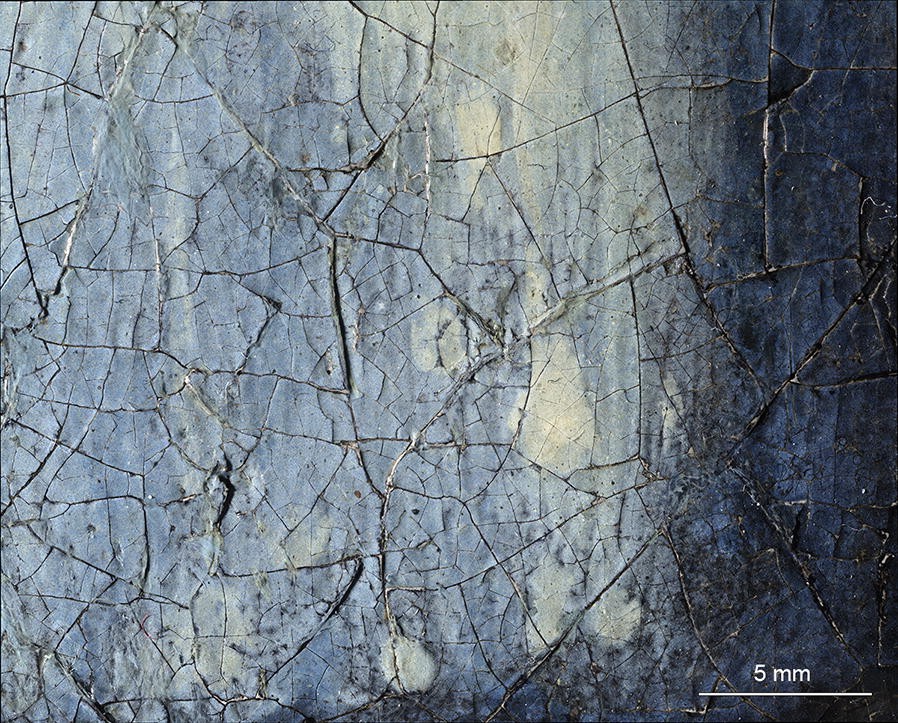
The border of the headscarf at ×140. The dots were painted with lead-tin yellow; the scale bar is 5 mm. Fig. 4 from Vandivere, Wadum & Leonhardt, "The Girl in the Spotlight: Vermeer at work, his materials and techniques in Girl with a Pearl Earring", Heritage Science 8 (2020), shown unchanged under CC BY 4.0. Not supplied or endorsed by the Mauritshuis; not the image we print.
Context
- Pearls, real and imitation, were fashionable from about 1650 to 1680; they turn up in paintings by Frans van Mieris, Gabriel Metsu and Gerard ter Borch. (Mauritshuis)
- Seventeenth-century Dutch girls did not wear turbans; it gives her an "Oriental air." Rembrandt had made tronies popular around 1630. (Mauritshuis)
- Vermeer worked from back to front: background and skin first, then the yellow jacket, white collar, headscarf and finally the pearl. He shifted the ear, the top of the headscarf and the back of the neck as he went. (Mauritshuis, 2018 research)
- It is signed upper left "IVMeer," hard to see now because the background has degraded. (Mauritshuis; npj Heritage Science, 2020)
- Abraham Bredius, later director of the Mauritshuis, saw it in Des Tombe's house in 1885 and wrote that "that single gleam of light, will alone hold your attention." (Mauritshuis)
- The museum lists the painting on view in Room 15. (Mauritshuis, checked 27 Oct 2026)
Which print
Our print reproduces the Mauritshuis canvas (inv. 670), the only version. We print from a faithful public-domain photograph on Wikimedia Commons; Vermeer died in 1675. The museum doesn't supply or endorse the file. The print is 5:6 portrait, with a sliver trimmed from each side, and the 15×18 size is almost exactly the real canvas. → Vermeer, Girl with a Pearl Earring (c. 1665) fine art print
Also from the dossier shelf:
- Two Sisters (On the Terrace): another famous pair of faces whose title says more than the record.
- The Starry Night: another icon people think they already know.
- The Great Wave: one image, many impressions, and which one we print.
FAQ
Why is it so hard to look away? In 2024 the Mauritshuis published a study it had commissioned (Neurofactor with Neurensics). Eye tracking showed viewers look at her eyes and mouth, then at the pearl, then back to the face, again and again. The researchers call this a "sustained attentional loop", and it appeared only for this painting among the five tested. The study was small: 20 people with EEG and eye trackers, and 20 in an fMRI scanner. The five paintings on the route were this one, Honthorst's Violin Player, a Rembrandt self-portrait and Anatomy Lesson of Dr Nicolaes Tulp, and Vermeer's View of Delft. On EEG, she drew the most attention of all five, more even than the museum's lift, which the researchers measured as a benchmark. In the fMRI scans, the precuneus, an area linked to self-reflection, was notably active for her. It is a museum-commissioned report, not a peer-reviewed paper. (Mauritshuis press release; report, 2 Oct 2024)
Is seeing the real painting different from seeing a print? Yes, by the museum's own measure. In the same study, the same people also looked at full-size posters of the portraits and tronies. The real paintings produced an "approach" response about ten times stronger (average 0.35 against 0.03), and the Girl's poster differed significantly from every real painting. Attention dropped less: about 1.16 times higher for the paintings than for the posters. In short, standing in front of the object hits hardest. A fine-art print is a home-scale record of that object, made to live with every day. It isn't a claim to stand in for the room in The Hague. (Mauritshuis/Neurensics report, 2 Oct 2024, pp. 8–9)
Where is Girl with a Pearl Earring? The Mauritshuis, The Hague, inventory number 670.
When was it painted? Around 1665, in Delft.
How big is it? 44.5 × 39 cm (17½ × 15⅜ in.), smaller than most people expect.
Who is the girl? No one knows. It is a tronie, a study of a type, not a commissioned portrait.
Is the pearl real? Probably not. The museum says it is too large to be real and may be glass, or Vermeer's invention.
What did it cost in 1881? Two guilders plus thirty cents mark-up, at the Braams sale in The Hague. (Mauritshuis provenance)
Was it always in the Mauritshuis? Des Tombe lent it to the museum in 1881 and it came by his bequest in 1903. (Mauritshuis provenance)
Why is the background black? It was a very dark green: a black underlayer with an indigo-and-weld glaze on top. The glaze has faded, hiding both the curtain folds and the signature. (Heritage Science 2019; 2020)
Can I see the scans? Yes. The Mauritshuis research page and the open-access Heritage Science papers publish the infrared and MA-XRF images; we link to them rather than reproduce them.
Where did Vermeer's paints come from? Lead white from English ore, cochineal red from the Americas, ultramarine from Afghan lapis lazuli, and weld that almost certainly grew in the Netherlands. (Mauritshuis; npj Heritage Science 2020)
Is the image public domain? Yes. The painting is public domain and we print from a faithful public-domain photograph. No museum endorses this shop.
Sources
- Mauritshuis / Neurofactor & Neurensics, "The unconscious emotions that art evokes" (report, 2 Oct 2024): sustained attentional loop, eyes–mouth–pearl
- Mauritshuis: Girl with a Pearl Earring, c. 1665, inv. 670 (catalogue text after Van der Ploeg & Buvelot 2005, details, provenance)
- Mauritshuis: Closer to Vermeer and the Girl (2018 research: green curtain, underlayers, pigments, ultramarine, eyelashes, no hook)
- Mauritshuis press release: Closer to Vermeer and the Girl
- Vandivere, Wadum & Leonhardt, Heritage Science 8 (2020): The Girl in the Spotlight: Vermeer at work, his materials and techniques (open access)
- Vandivere et al., Heritage Science 7 (2019): Fading into the background: the dark space surrounding Vermeer's Girl with a Pearl Earring (open access)
- Vandivere et al., Heritage Science (2020): The technical (re-)examination of Vermeer's Girl with a Pearl Earring (open access)
- Wikimedia Commons: 1665 Girl with a Pearl Earring (public-domain image file)
Quotations are short and attributed. Everything else is paraphrased.