
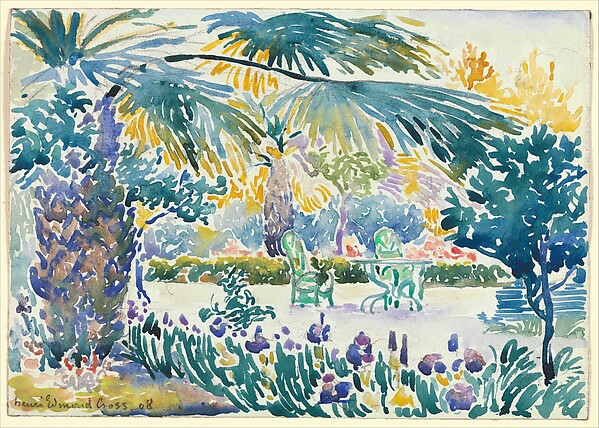
Short answer (updated 27 Oct 2026): Henri-Edmond Cross's The Artist's Garden at Saint-Clair (1904–5) is a watercolor, not an oil painting. It's a sheet about 26.6 × 35.8 cm (10 1/2 × 14 1/8 in.) in The Met's Drawings and Prints department, accession 48.10.7, bought with the Harris Brisbane Dick Fund in 1948. The Met also owns a second, later view of the same garden: Garden of the Painter at Saint Clair (1908), in the Robert Lehman Collection. So "Cross's garden at Saint-Clair" can mean two different works. (The Metropolitan Museum of Art)
The fact gap: one garden, two Met watercolors
| What people assume | What the record says | |
|---|---|---|
| Medium | A Neo-Impressionist oil on canvas | Watercolor on paper. The Met classifies it as a drawing. Its Cross oils, like Pines Along the Shore (1896) and Valley with Fir (1909), are separate works. (The Met) |
| Which garden picture | There's only one | The Met has two: this one (1904–5, 48.10.7, Drawings and Prints) and Garden of the Painter at Saint Clair (1908, 1975.1.590, Robert Lehman Collection), which is smaller at 17.1 × 24.1 cm and drawn in watercolor over graphite. (The Met) |
| Size | Wall-sized | About 26.6 × 35.8 cm, roughly the size of a sheet of printer paper. (The Met) |
| Artist's name | Related to Eugène Delacroix | He was born Henri-Edmond Delacroix and worked as "Cross." The Met lists his life as Douai 1856 to Saint-Clair 1910, so he died where this garden was. (The Met; Getty ULAN) |
| Technique | Seurat-style dots | Separate patches of color, but broad and blocky rather than tiny uniform dots. The Met's label says that on the Mediterranean coast Cross "relaxed the rigorous optical arrangements of the Divisionist technique in favor of a style of painting using long, blocky brushmarks in decorative, mosaic-like patterns." (The Met) |
Side by side: 1904–5 vs 1908
The later Lehman sheet is watercolor over graphite and about two-thirds the size (17.1 × 24.1 cm vs 26.6 × 35.8 cm). (The Met)
The 1908 sheet, Met 1975.1.590 (Open Access, CC0). Not the work we print.
Three details worth looking at
- The paper is part of the picture. Bare paper shows between the strokes and does the work of highlights. (Our reading)
- Warm against cool. Oranges and teals sit next to each other without blending, so your eye does the mixing from a distance. (Our reading)
- Strokes like tiles. Each touch is a separate block, not a dot. Compare it with the 1908 Lehman sheet of the same garden and you can see how loose his hand got. (Our reading)
Context
- Cross (French, 1856–1910) is grouped with Seurat and Signac among the Neo-Impressionists. The Met's Lehman Collection holds his oils, Seurat drawings and Signac alongside his watercolors. (The Met)
- 1891 was his turning point. That year, after Seurat's death, he showed his first Neo-Impressionist painting, Portrait of Mme Hector France (Musée d'Orsay). The sitter was Irma Clare, then married to the novelist Hector France and later Cross's wife. In October he left Paris with her for the Var. He chose Cabasson, a hamlet near Bormes and Le Lavandou. From 1893 he had a house built at Saint-Clair, married Irma, and left it after that only for short stays in Paris and trips to Venice (1903) and Tuscany and Umbria (1908). (French Ministry of Culture, DRAC PACA; Musée des impressionnismes Giverny; Musée d'Orsay)
- Why this sheet is a watercolor: at Saint-Clair he let his art open up, "notably through the use of watercolour from 1903." This 1904–5 garden belongs to that late turn to paper. (DRAC PACA, our translation)
- Why the strokes are blocks, not dots: from 1895 he widened his touch, making it freer and less regular, then grouped colours in masses to sharpen the contrast of warm and cool tones, exactly the orange-against-teal you see here. (DRAC PACA)
- Rheumatism was part of the reason for the move. His studio stood in the garden, which became both a frequent subject and a meeting place for Neo-Impressionist painters in the south. (Jordan Schnitzer Museum of Art, University of Oregon)
- In his own words. "In summer… the light streaming profusely down on everything attracts you, stupefies you, drives you mad," he wrote to a friend in 1901 (quoted by the Jordan Schnitzer Museum of Art). To Charles Angrand that year: "Our beaches here are deserted… But how eternally beautiful it is!" (Musée des impressionnismes Giverny). And in 1906, to his friend and biographer Lucie Cousturier: "I still believe this country is the most beautiful in the world" (French original: « Je persiste à croire que ce pays est le plus beau du monde », which the DRAC PACA dossier quotes after his note that the mistral had been blowing for three days "under a relentlessly blue sky." English is our translation of the dossier's French.)
- The garden as a meeting place. The Met's label says Cross "painted many radiant watercolors of his semi-tropical garden in Saint-Clair, where he and Paul Signac often entertained." It names Matisse, André Derain and Albert Marquet, "artists later associated with the Fauve movement," as frequent guests. (The Met. The label prints "Pierre Matisse"; given the 1904 Saint-Tropez summer, Henri Matisse is presumably meant.)
- Signac found Saint-Tropez in 1892 and spent every summer there. The two painters saw each other regularly in summer and wrote to each other about colour in winter. (DRAC PACA)
- In summer 1904, the year this sheet was begun, Matisse stayed in Saint-Tropez and painted with Signac and Cross in the divisionist technique. Cross met him at Signac's for long discussions about colour. (Musée Matisse, Nice; DRAC PACA)
- His first solo show was at Galerie Druet in Paris in 1905, followed by Bernheim-Jeune in 1907. He died of cancer at Saint-Clair in 1910 and was buried in the cemetery of Le Lavandou. (DRAC PACA)
- The Met holds more than a dozen Cross watercolors of the Mediterranean coast, Venice (1903) and Cap Nègre (1909). Saint-Clair was the coastal village where he lived and died. (The Met)
- The Met marks this sheet public domain under its Open Access program. (The Met)
Which one to hang
Our print reproduces the Met's The Artist's Garden at Saint-Clair, 1904–5, 48.10.7, from the museum's Open Access image (DP805782, CC0). It's not the 1908 Lehman sheet. The sizes are landscape, to match the original. → Cross, The Artist's Garden at Saint-Clair fine art print
Also about color more than subject:
- Redon, Bouquet in a Chinese Vase: a late Met flower picture with the same unreal palette.
- Water Lilies, 1906: Monet's garden, a couple of years later.
FAQ
Is it an oil painting? No. It's watercolor on paper, and The Met catalogues it as a drawing.
When was it made? 1904–5.
Where is it? The Metropolitan Museum of Art, New York, Drawings and Prints, accession 48.10.7. Works on paper are shown only now and then because they're sensitive to light.
Is it the same as the Met's 1908 garden at Saint Clair? No. That's a separate, smaller watercolor (1975.1.590) in the Robert Lehman Collection.
Was Cross related to Eugène Delacroix? No link is recorded. He was born Henri-Edmond Delacroix and from 1883 translated his surname into "Cross" precisely to set himself apart from the memory of Eugène Delacroix. In 1887 he settled on "Henri Edmond Cross" to avoid confusion with the artist Henry Cros as well. (DRAC PACA)
When did he start using dots? In 1891. He had helped found the Salon des Indépendants in 1884 and knew Seurat and Signac, but waited five years after them to take up the divided touch. (DRAC PACA; Musée d'Orsay)
Who owned it before The Met? Félix Fénéon, the critic who named Neo-Impressionism. The Met lists him as its only recorded owner; the sheet was lot 5 in the second sale of his collection at the Hôtel Drouot, Paris, on 30 May 1947, and The Met bought it the next year through the Harris Brisbane Dick Fund. It is signed with initials only, "E.C.", lower left. (The Met, Provenance, Signatures and References tabs)
Has it been exhibited? Yes. The Met lists the Guggenheim's "Neo-Impressionism" show in New York (1968; Robert L. Herbert's catalogue no. 23), the Louvre's Cabinet des dessins show of French drawings from the Met (Paris, 1973–74, cat. no. 17), Met collection selections in 1989 and 1996, and the Met's "Public Parks, Private Gardens: Paris to Provence" (2018, catalogue p. 180). Before that it was lot 5 in the second Fénéon sale at the Hôtel Drouot in 1947. (The Met, Exhibition History and References, read 28 Oct 2026)
Is the image public domain? Yes. The Met releases it under Open Access (CC0). The museum does not endorse this shop.
Sources
- The Met — Henri-Edmond Cross, The Artist's Garden at Saint-Clair, 1904–5, 48.10.7 (incl. Exhibition History and References tabs, read 28 Oct 2026)
- The Met Open Access record 334087 (medium, dimensions, credit line, public-domain status)
- The Met — Cross, Garden of the Painter at Saint Clair, 1908, 1975.1.590
- The Met — Cross, Pines Along the Shore, 1896, oil, 1975.1.164
- The Met — Cross, Valley with Fir (Shade on the Mountain), 1909, oil, 1975.1.163
- The Met — Cross, Cap Nègre, 1909, 1975.1.596
- The Met Open Access record 459733 (1908 sheet: medium, dimensions, image DP359009)
- French Ministry of Culture, DRAC PACA — Henri-Edmond Cross, dans la lumière du Var (2023 exhibition dossier, PDF: biography, 1891 move, Saint-Clair, name change, watercolour from 1903, 1906 letter)
- Musée des impressionnismes Giverny — Color and Light: The Neo-Impressionist Henri-Edmond Cross (October 1891 move, Irma Clare portrait, 1901 letter to Angrand)
- Musée d'Orsay — artist record, Henri-Edmond Cross (pointillism from 1891)
- Jordan Schnitzer Museum of Art — Henri-Edmond Cross research guide (rheumatism, garden studio, 1901 letter)
- Musée Matisse, Nice — biography, 1904 (summer in Saint-Tropez with Signac and Cross)
- Getty ULAN — Henri-Edmond Cross (1856–1910)
- The Met — 48.10.7, Provenance (Félix Fénéon), References (Fénéon sale, Hôtel Drouot, 30 May 1947, cat. 5) and Signature ("E.C.", lower left) tabs
Quotations are short and attributed. Everything else is paraphrased.